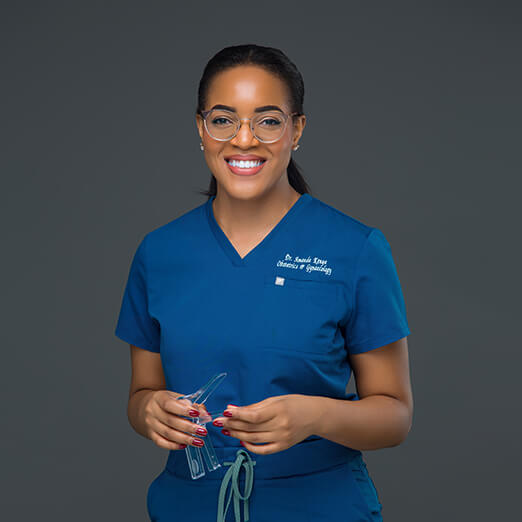
In this edition of Meet the Fellows, we introduce you to Dr. Amanda Kenya — one of the Maxine Granovsky-Gluskin Fellows at the Weston and O’Born Centre for Mature Women’s Health.
Dr. Kenya shares about how her passion for caring for women experiencing menopause led her from Kenya to Toronto and how the mature women’s health fellowship is giving her hands‑on experience, expert mentorship and the confidence to bring specialized care and education back to her home health-care system.
Q: Can you tell me about your path to medicine? What inspired you to want to become a doctor?
Dr. Amanda Kenya: I always wanted to be a doctor. I was inspired by my uncle, who was the first doctor in the family. I saw how people respected him and how meaningful his work was. The way he talked about his job, his patients and the things he did, I just thought it was so interesting.
Even as a child, I identified with it completely. In primary school, when we had to label our exercise books, I would write “Dr. Amanda Kenya.” I was about 10 years old and already calling myself “Dr.” I honestly believe I manifested it very early on and then just kept working toward it. In my mind there was no other option.
Q: When did you start to think about specializing in obstetrics and gynaecology?
Dr. Kenya: During my internship after medical school, I started with a rotation in obstetrics and gynaecology, and at first I thought, ‘This is chaotic — there’s no way I’m coming back here.’ So I went on to rotations in internal medicine, surgery and pediatrics.
But something kept pulling me back to OB-GYN. It’s exciting and incredibly varied. You get surgery, elements of internal medicine and you still get to interact with precious babies. Every day looks different. Eventually, I realized this was the right fit for me, and I decided to stay and complete my residency in this field.
Q: Your focus later shifted toward menopause care – an area many clinicians say they aren’t well trained in. How did that happen?
Dr. Kenya: When I started practicing as a gynaecologist, my friend sent her mother to me, who was experiencing severe menopause symptoms. She had seen various gynaecologists and was not able to get help. She was being prescribed different medications, but they were not very effective. I had to do my own research because, to be honest, we weren’t really taught much about menopause in medical school or even specialist training.
I ended up finding the hormone therapy she needed, somewhere in the city — they were not easily available — and prescribing them to her. She did remarkably well and she started telling all her friends about me. Before I knew it, 90 per cent of my patients were coming for menopause care.
At that point, I realized I didn’t have a mentor. I was teaching myself, and menopause is an area where you really need to learn from experts. Not everything is in textbooks or guidelines — you need clinical experience and nuanced judgment. That’s when I began looking for specialized training.
Q: What led you to apply to become a Fellow at the Centre?
Dr. Kenya: I actually asked ChatGPT where I could get advanced training in menopause and mature women’s health. At the time, this fellowship was the only one in the world fully dedicated to menopause and mature women’s health rather than covering it as a small part of a larger program.
I saw that they accept only two fellows each year — one Canadian and one international — and thought, ‘There’s no way I’ll get in.’ But I applied anyway. I submitted my application in early 2025, interviewed midyear and then received the email saying I was accepted. I started in August, all within a year. It happened very quickly. They were very organised.
Q: What has surprised you most about the fellowship so far?
Dr. Kenya: It’s honestly everything I hoped it would be — and more. It’s very practical and hands-on. I didn’t expect the patient volume to be so high, but that’s a good thing. The more patients you see, the more confident you become.
I’ve also been exposed to a wide range of conditions and procedures. Being supervised while still having the freedom to practice and learn has been incredible. It’s an environment where you’re trusted, but also supported. I couldn’t ask for a more conducive environment to hone my skills.
Q: You’ve spoken about taking what you’ve learned back to Kenya. How has this fellowship prepared you to do that confidently?
Dr. Kenya: The confidence comes from practice. I won’t just be relying on guidelines or textbooks — I’ll be relying on what I’ve actually done. There’s a saying we use: ‘bodies don’t read books’. You can follow the rules perfectly, and patients still respond differently. Having seen such a wide variety of patients and presentations means I know how to adapt safely and thoughtfully. That kind of confidence only comes from hands-on experience under expert mentorship. It also puts me in a position to teach others and help grow capacity, because one person can’t do it all alone.
Q: Why is funding fellowships like this so important?
Dr. Kenya: The impact of this fellowship goes far beyond Toronto or even Canada. These fellowships create a pipeline of trained clinicians who take their expertise around the world. When you train under someone as influential and trusted as Dr. Wendy Wolfman (Director of the Weston and O’Born Centre for Mature Women’s Health), people know that you’ve received a very high standard of education.
It’s also an equity issue. Menopause care often becomes a luxury — only available to women who can afford private care. That’s true in Canada and globally. But menopause is something almost all women will experience, and many of us will spend half our lives in it. This care should not be optional or inaccessible. Funding allows this knowledge to spread, creating hubs of expertise that can support women of all socioeconomic and cultural backgrounds. That’s how we change systems, not just individual practices.
Q: Looking ahead, what are you most excited about in the next phase of your training?
Dr. Kenya: I’ve decided to stay at Mount Sinai Hospital in the Weston and O’Born Centre for Mature Women’s Health for an extra year because I’m learning so much and really enjoying my time here. I’m particularly interested in premature ovarian insufficiency research, which aligns with Dr. Wolfman’s interests, and that will be the focus of my fellowship research.
I’m also passionate about patient education. We often have limited time with patients, but information is powerful. I want to develop educational tools that help women understand how to care for their bodies and age healthily.
On top of that, I’ll be starting a master’s program in clinical informatics at Johns Hopkins University. Combining data, technology and menopause care opens up so many possibilities for improving systems and access. I’m excited to see where that leads.
Your support helps train the next generation of menopause experts
The Mature Women’s Health Fellowship program at the Weston and O’Born Centre for Mature Women’s Health is only possible thanks to the generosity of our donor community. This first of its kind program has trained more than 30 fellows from six countries, who will go on to share the knowledge they gain here with institutions locally, nationally and around the world.
Help us transform the future of mature women’s health. Donate today.
Stay up to date with the centre and sign up for our newsletter